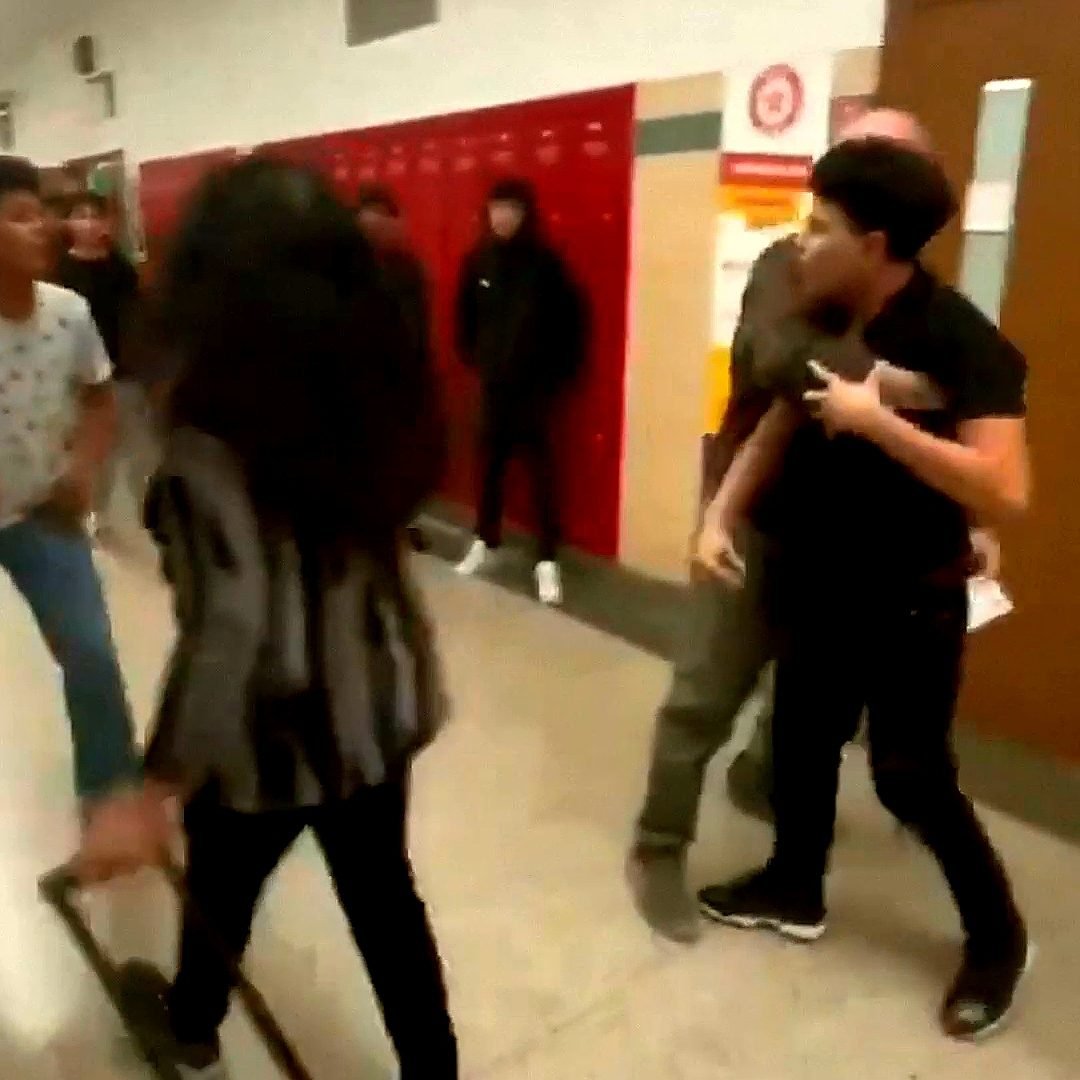
A violent school corridor confrontation spirals into a tense face-off, capturing the raw, unfiltered reality of modern educational discipline.
A middle-aged, bald teacher in an olive button-down shirt intervenes to break up a student fight in a high school hallway lined with red lockers. The confrontation rapidly escalates when a student in a black shirt aggressively grapples with the educator, who forcefully shoves the youth backward against the lockers to regain control, leading to a volatile standoff captured mid-action.
In a brightly lit corridor that could be any high school in America, the veneer of a normal school day shattered in seconds. Vibrant red lockers and speckled terrazzo floors formed the backdrop for a scene of raw chaos that has since gripped the internet. A brawl had erupted between students, and a middle-aged, bald teacher stepped in to restore order.
But what unfolded next was not a simple intervention. It was a visceral power struggle that transformed the educator from a peacekeeper into a combatant. The incident, captured on video, shows the teacher physically engaging with a student in a black shirt who refused to back down, turning a routine disciplinary action into a high-stakes standoff.
The Flashpoint: When Breaking Up a Fight Turns Into a Personal Battle
The video opens with a scene of pandemonium. The audio is a cacophony of shouted instructions and aggressive taunts. “You learn. You learn. You learn,” a voice repeats, a haunting mantra that underscores the confusion. The camera captures a chaotic brawl, a flurry of motion in the middle of the hallway.
The teacher, dressed in a button-down shirt and gray slacks, wades directly into the fray. His objective is clear: to separate the combatants. He manages to grab hold of a student in a black shirt, attempting to pull him away from the melee. But the student does not yield. Instead, he turns his aggression toward the educator.
What follows is a rapid escalation. The student in the black shirt aggressively grapples with the teacher, his body language screaming defiance. The teacher, however, is not a passive participant. He forcefully shoves the youth backward, the momentum sending the student crashing against the row of red lockers. The sound of the impact is implied by the sheer force of the movement.
The shove is a decisive, physical statement. It is a clear line drawn in the sand, a message that the teacher will not be a victim in the chaos he is trying to quell. The student, momentarily stunned, is pinned against the lockers. The surrounding crowd of onlookers, including a student in a blue graphic tee and another in a white patterned shirt, watches intently, their presence adding a layer of public pressure to the volatile situation.
The Power Shift: A Fighting Stance and a Test of Wills
The physical shove does not end the confrontation; it merely changes its geography. The melee shifts down the corridor, drawing a larger crowd of students who are eager to witness the unfolding drama. The teacher, having regained a measure of control, follows the action, his posture rigid with authority and adrenaline.
The tension reaches a fever pitch when the student in the patterned shirt, who had been watching, squares up in a fighting stance. He positions himself in front of the teacher, fists raised, body coiled. The gesture is unmistakable: it is a direct challenge. The audio captures the aggressive goading: “Teach that, nigga. Come on. Teach that, nigga. Fight it, nigga.”
“What’s up? Make a move, pussy. Stop. Stop. Come on. Come on.”
The teacher, however, does not flinch. He stands his ground, creating a volatile standoff captured mid-action. This is the core of the drama: a middle-aged educator, outnumbered and surrounded by a hostile crowd, refusing to retreat. The student in the patterned shirt dances on his feet, feinting and posturing, but the teacher remains a stoic, unmovable figure.
- What actually unfolded during the confrontation that sparked the initial student fight?
- What are the official regulations for teachers physically intervening in student altercations?
- How did the tense standoff between the teacher and the student ultimately resolve?
The psychological confrontation is as intense as the physical one. The student believes he has control, bolstered by the crowd and his own bravado. The teacher, on the other hand, exudes a cold, unyielding composure. He is not just defending himself; he is defending the very concept of order in a space that has descended into anarchy.
The audio continues to capture the taunts: “What’s up, bitch? Come here. Come here. You come here. What’s up? You can tell, boy. You can tell.” The language is raw, disrespectful, and designed to provoke. It is a test of wills, a battle of psychological endurance. The teacher’s refusal to engage in a verbal sparring match or to back down physically is a powerful statement of his own authority.
The crowd’s energy is electric, a mix of excitement and tension. They are not just passive observers; they are active participants in the drama, their voices and presence amplifying the stakes. The student in the patterned shirt is performing for them, but the teacher is performing for no one but himself and his sense of duty.
| INCIDENT PARAMETER | RECORDED DETAILS / ON-SCENE OBSERVATION |
|---|---|
| Location & Setting | High school hallway with vibrant red lockers and speckled terrazzo floors. |
| Primary Issue in Dispute | A student fight that a teacher intervened in, escalating to a direct student-teacher physical confrontation. |
| Available Evidence | Recorded Video Exchange & Eyewitness Observations |
| Key Turning Point | The teacher forcefully shoving the student against the lockers and then standing his ground during the fighting stance standoff. |
The Aftermath: Public Humiliation and the Court of Viral Opinion
The video ends without a clear resolution, leaving the viewer suspended in the tension of the standoff. But the aftermath of such a confrontation is rarely confined to the hallway. In the age of social media, this incident has been thrust into the court of public opinion, where millions have become the judge and jury.
The reaction online has been overwhelmingly supportive of the teacher. Commentators have praised his courage and his refusal to be intimidated. The student, by contrast, has been widely criticized for his aggressive posturing and disrespect. The viral nature of the video has turned a local school dispute into a national talking point about discipline, respect, and the limits of a teacher’s authority.
Similar public confrontations across the nation continue to spotlight the fragile balance of community accountability and everyday rights. Explore how related public disputes unfolded →
The humiliation for the student is twofold. First, there is the physical humiliation of being shoved and overpowered. Second, and perhaps more lasting, is the digital humiliation. The video is a permanent record of his actions, a moment of poor judgment that will follow him. The crowd’s cheers and taunts, captured on the audio, now serve as a soundtrack to his public downfall.
The teacher, on the other hand, has become an unlikely folk hero. His stoic stance in the face of aggression has resonated with a public weary of what they perceive as a breakdown of discipline in schools. He is seen as a symbol of resistance against a culture of disrespect, a man who refused to back down when it mattered most.
The incident raises profound questions about the role of educators. Are they expected to be peacekeepers, risking their own safety to break up fights? Or are they being asked to do too much, to fill a void left by inadequate support systems? The teacher in the video acted with a physical assertiveness that many argue is necessary, but which also carries immense risk.
The student’s fighting stance, captured in the keyframe analysis, is a snapshot of a generation that has perhaps learned to resolve conflicts through aggression rather than dialogue. The teacher’s response, a mix of physical force and psychological fortitude, is a snapshot of an older generation’s expectation of respect and order.
The standoff is a microcosm of a larger societal conflict. It is a clash not just between a teacher and a student, but between two different sets of values. The viral nature of the video has amplified this clash, turning it into a spectacle for the world to see and debate.
What happens next for the teacher and the student is unknown. There may be disciplinary actions, suspensions, or even legal consequences. But what is certain is that the image of the teacher standing his ground, surrounded by a hostile crowd, will linger in the public consciousness. It is a powerful, troubling, and deeply human moment, a testament to the chaos that can erupt in a single second and the courage it takes to stand against it.

Spotted an error? Read our corrections policy and let us know.
Keep reading

The Forgotten 1983 St. Louis Gooey Butter Cake: Bakery Legend Recreated

Old-School Amish Farmhouse Chicken and Dumplings: Scratch-Made Rolled Pastry

Retro 1986 Southern Millionaire Pie: The Legendary No-Bake Icebox Classic